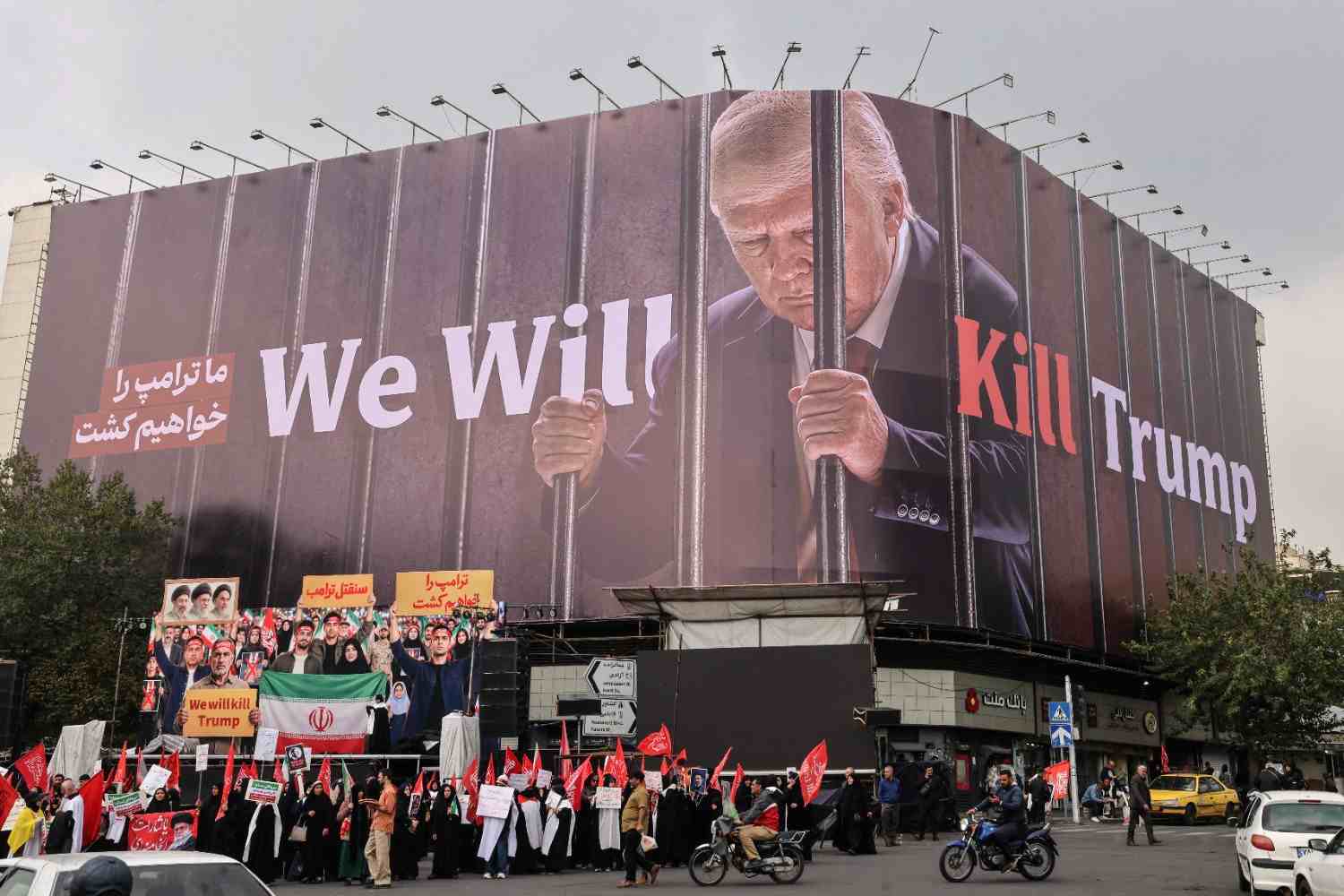
Tehran. Iran has released huge hoarding boards and banners threatening to kill US President Donald Trump in different places of the capital Tehran on Tuesday.
This has made the government-backed political campaign seen in the capital more aggressive.
A giant billboard in Tehran’s busy Engelab Square reads, “We will kill Trump.”
In it, US President Trump is depicted sitting with his head bowed inside the prison.
After the killing of Supreme Leader Ali Khamenei when the US and Israel attacked Iran on February 28, billboards and propaganda materials criticizing Trump and warning of revenge have been placed in various places in Tehran.
Meanwhile, new diplomatic efforts have been underway in recent days to bring Tehran and Washington to the negotiating table.
Its purpose is to prevent the spread of war in the Middle East again. Due to this war, prices have increased all over the world.
Trump said a deal with Iran could be reached as the US heads into crucial mid-term elections on Tuesday.
The election is coming at a time when American voters are increasingly dissatisfied with the war with Iran.
Various portraits of Trump have also been displayed at an open exhibition in the busy Tajris Square in northern Tehran.
One of the pictures shows her face on the ground covered in blood, while another shows a man with his legs over her head.
Another picture shows Trump’s face covered with a bomb. The painting appears to be inspired by Belgian surrealist painter René Magritte’s famous 1964 painting ‘The Son of Man’.
A prison cell-like structure has also been built near the exhibition. An actor dressed as Trump stays there all day.
A screen next to it shows scenes of damage from the US attack on Iran.
Iran has accused the US of deliberately targeting civilian areas such as schools and weddings during the war.
Iran claims that dozens of people, including women and children, died in those attacks.
Since the 1979 Islamic Revolution, public places in Iran have had a tradition of displaying government-sponsored giant billboards and murals.
These propaganda materials are used to honor allies, praise military figures and give political messages especially to hostile countries like the US and Israel.