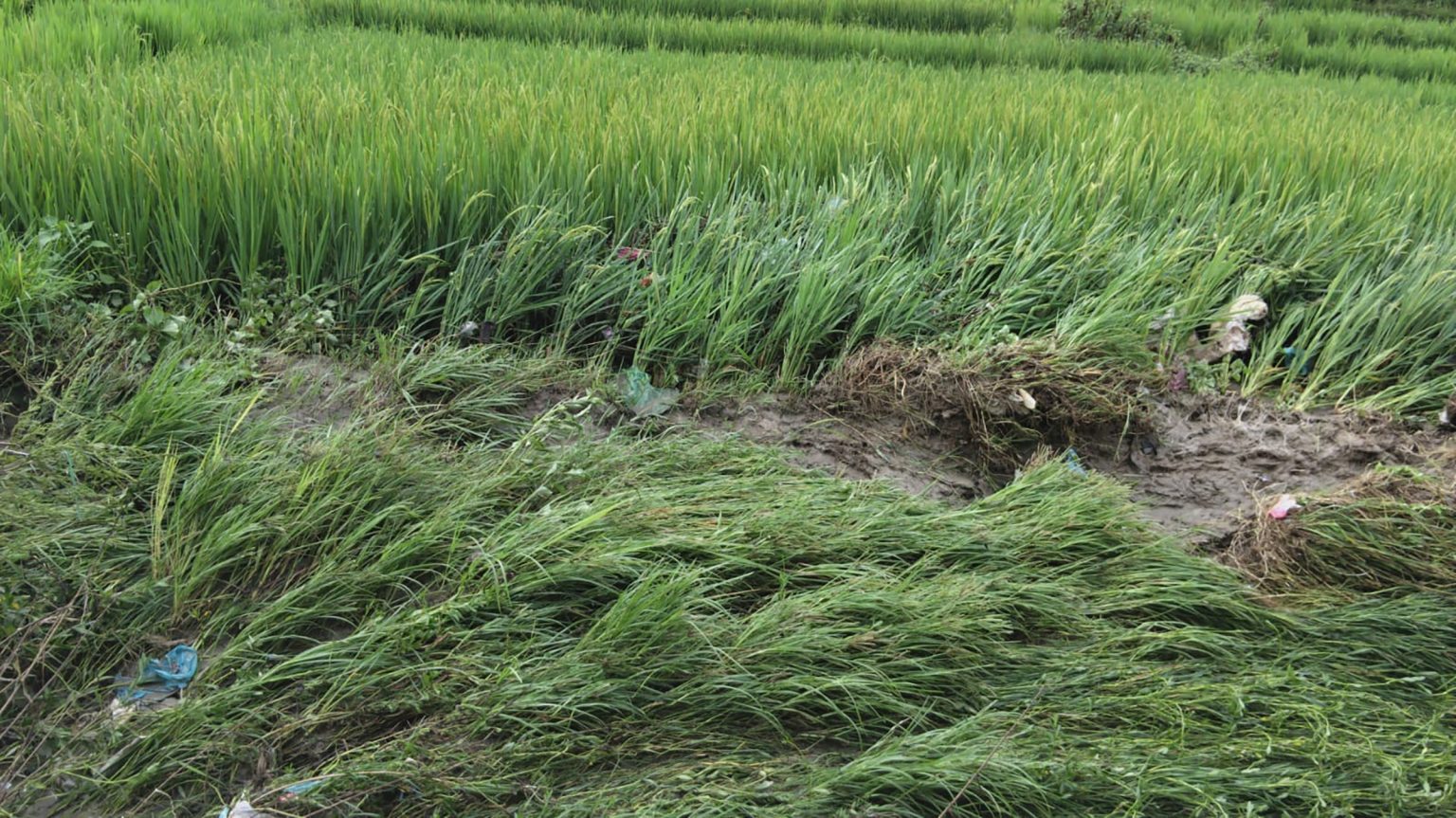
Chitwan. Farmers of Madi in Chitwan have become worried after seeing various diseases in the paddy fields till last year, after sowing, various diseases have appeared, till the time of ripening, and only empty pods (Tatla) have been found at the time of harvesting.
There is a concern that there will be a problem in gathering grain for consumption throughout the year after the production of new varieties of rice has decreased. Farmers are reaching the agricultural branch of the municipality every day, looking for a solution to the damage and problems in paddy cultivation.
The problem has been noticed in the ‘Bioseed 301’ variety of paddy planted by the locals of Madi Municipality-7, 6, 5 and other areas after buying seeds from Agrovet. In addition to the appearance of various diseases in paddy, the farmers have not been able to get the expected production due to the problems of failure to produce sprouts, small sprouts even when sprouted, and only dry leaves without seeds.
According to Madi Municipality Agriculture Branch, blast and brown spot disease were observed in the rice of that variety. Head of Agriculture Branch Suresh Sinkha said that despite the use of pesticides on the advice of the Agriculture Branch and local Agrovet to control the disease, the problem could not be controlled.
According to him, there was a problem of paddy not setting and grain not setting even at the time of paddy threshing and tillering. He informed that in the on-site monitoring conducted after the complaint of the farmers, there were no pods in the rice of that variety and in the fields with pods, diseases such as neck blight, brown spot and Marchat blight were observed in large numbers.
The head of the agriculture branch, Sinkha, said, “After receiving a complaint about the problem of rice in the city’s agriculture branch, during the on-site monitoring of the farmers’ paddy fields, it was found that the crops of that variety did not produce pods and even in the fields that did produce pods, there was an infection of diseases such as neck rot, gray spot and March blight. Now, the problem of pods not producing at the time of ripening has been noticed. Farmers are coming to the municipality and asking them to solve the problem.”
During the conversation with the local agrovet, it was found that about 3,000 kg of seeds of the said variety were sold and distributed in the Madi area and cultivated in an area of about 100 hectares, according to the agriculture branch. According to the registration details of the Seed Quality Control Center, the paddy ripens in 129 days.
The head of agriculture branch, Sinkha, said that after the paddy planted from June 15 to mid-October did not produce seeds in the fields of many farmers, the quality of the seeds was raised. He said that most of the farmers who have planted the said rice have similar problems in their fields, so it is suspected that the seeds may be affected.
According to him, the Agriculture Branch has informed the Agriculture Development Office, Bharatpur and the State Seed Quality Control Center about the problem. The Center has also conducted an on-site inspection of the affected areas. Sinkha said that now the agriculture branch is collecting the details of the damage from the farmers and the representatives of the seed companies are being called and discussions are being held on how to deal with the damage.
Losses when planting new varieties of paddy
Gobind Bhandari of Madi-7 Kirtanpur was producing up to five muri of paddy in one paddy till last year. This year, when a new variety of rice was planted, the plants did not grow well in his field. He bought the seeds and planted them saying that it would be a new breed of rice that would give sweet and smooth rice when eaten.
After planting, diseases started appearing in the paddy, he used pesticides many times to control the disease. However, by the time it was time to harvest rice, only plants and pods could be seen in the field. He farmed in the hope of producing enough rice to eat throughout the year and now he is worried about the lack of production.
“Now, it was planted to plant a new variety of rice, but it did not grow and was wasted. When the rice was harvested, there were only husks, no grain”, said Bhandari. He claimed that the problem was in the seeds. He said that the farmers who planted the same variety of rice in the surrounding fields along with the rice they planted also had to face the same problem. He said that after planting, the rice plants die, the remaining plants turn white and the grain does not grow.
Bhandari expressed his sadness that such a problem was not seen before in Savitri, Gorakhnath and other paddies which are grown traditionally. He says that this year’s crop has been wasted due to the decision to plant a new variety of rice. He has informed the agriculture office and the seed seller about the problem.
Savitri Chapagai of Madi-6 Kalyanpur has the same pain. This year, she cultivated paddy in her own field with the aim that her husband, who is abroad, could return home and do something on his own land. He expected to collect grain and earn income for his family by farming on the land that was previously leased to others. However, the condition of rice has disappointed him.
“After planting the paddy, it turned red. Later, the plant died and the pods did not grow. Such a problem did not occur until today. There was neither paddy nor straw”, said Chapagain. Stating that only two (four sacks) of paddy planted in an area of about 16 kathas were produced, he said that it was also not in edible condition. Although he expected good production from the farm in normal conditions, he said that the investment and effort was wasted this year.
Chapagain said that many farmers in the vicinity bought seeds to plant new varieties of rice and the same problem was observed in their fields. He suspects that there may be a problem with the quality of the seeds as some of the rice planted in places where new seeds are not enough have normal production.
This incident taught him to be more careful when choosing new seeds. He said that from now on, he will not only rely on the propaganda of the seed company or the advice of Agrovet, but he will cultivate with the advice of the agricultural technician and the agriculture office.
Damages will be determined after investigation
Jhalaknath Kandel, head of Agricultural Development Office Chitwan, said that information has been received that there is a problem with the new variety of rice in some areas of Madi. He said that based on the complaints of the farmers and the information received from the local agriculture branch, the problem is being investigated and the work is being done to understand the seed company.
He said that Agrovet, which sells seeds, will collect the details of where the seeds came from and proceed with the necessary process. Mentioning that farmers should pay attention to the source, quality and suitability of seeds while purchasing them, he suggested that they should not only rely on Agrovet’s advice but consult with agricultural technicians and related agricultural offices.
He said that it will be clear from the research whether the problem seen in rice is due to the disease or the quality of the seeds. The real cause of the problem and the extent of the damage will be determined only by collecting the details of the damage suffered by the affected farmers and testing the quality of the seeds. Rasas