

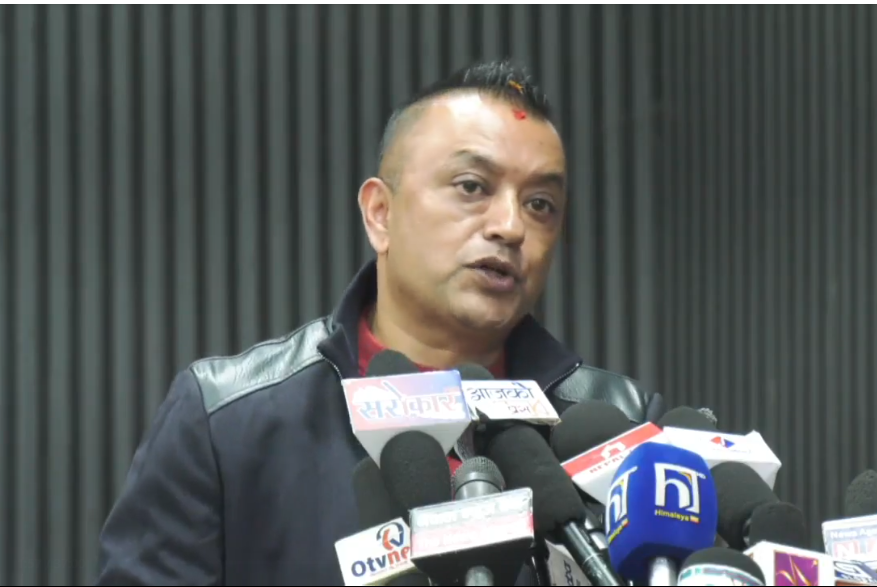
Kathmandu. Nepali Congress President Gagan Kumar Thapa has objected to the police arresting the employees including the Director General of the Irrigation Department.
Speaking at a press conference held at the party’s central office, Sanepa on Sunday, Thapa accused the Prime Minister’s office of adopting an arbitrary style that should be investigated through the established legal mechanism if there is a mistake by the staff.
He said that it was objectionable that the police arrested and pressured the Director General of the Irrigation Department, Dinesh Rajouria, and another project employee.
Mentioning that there is an agency in the country that investigates if the employees work against the rules, he said that it is not possible to proceed in a dictatorial style by deceiving the National Vigilance Center and the Commission for Investigation of Abuse of Authority.
“If an employee makes a mistake, they will not be called to the Prime Minister’s Office and arrested, but a lawful investigation will be carried out by the concerned official bodies,” he said.
Thapa said that the style of terrorizing the employees by bypassing the official mechanisms of the state cannot be democratic. He alleged that the government chose an arbitrary path, making a mockery of the rule of law, administrative dignity and the established legal mechanism.
Likewise, Thapa commented that the government’s attention was not focused on improving the economy. He said that when the national budget is under pressure due to natural calamities, the government’s priority should be to improve the economy.
He said that now employees, businessmen, police and constitutional bodies are under pressure and panic, and the government’s policies have increased the crisis of confidence.
He said, “We need to improve the sluggish economy not by envy, but by giving trust and confidence.”
Thapa also said that the Congress as the main opposition party is ready to help the government when it asks for help in improving the economy. He said that they are willing to help pass the bill or make necessary policy reforms.



